Home/News/Details

EU Revises Authorized List of Substances for Plastic Food Contact Materials, Adding Four New Entries

Nov 4, 2026
EU
FCMs
Favorite
Share
Unlock exclusive content and benefits? Sign up for free today!

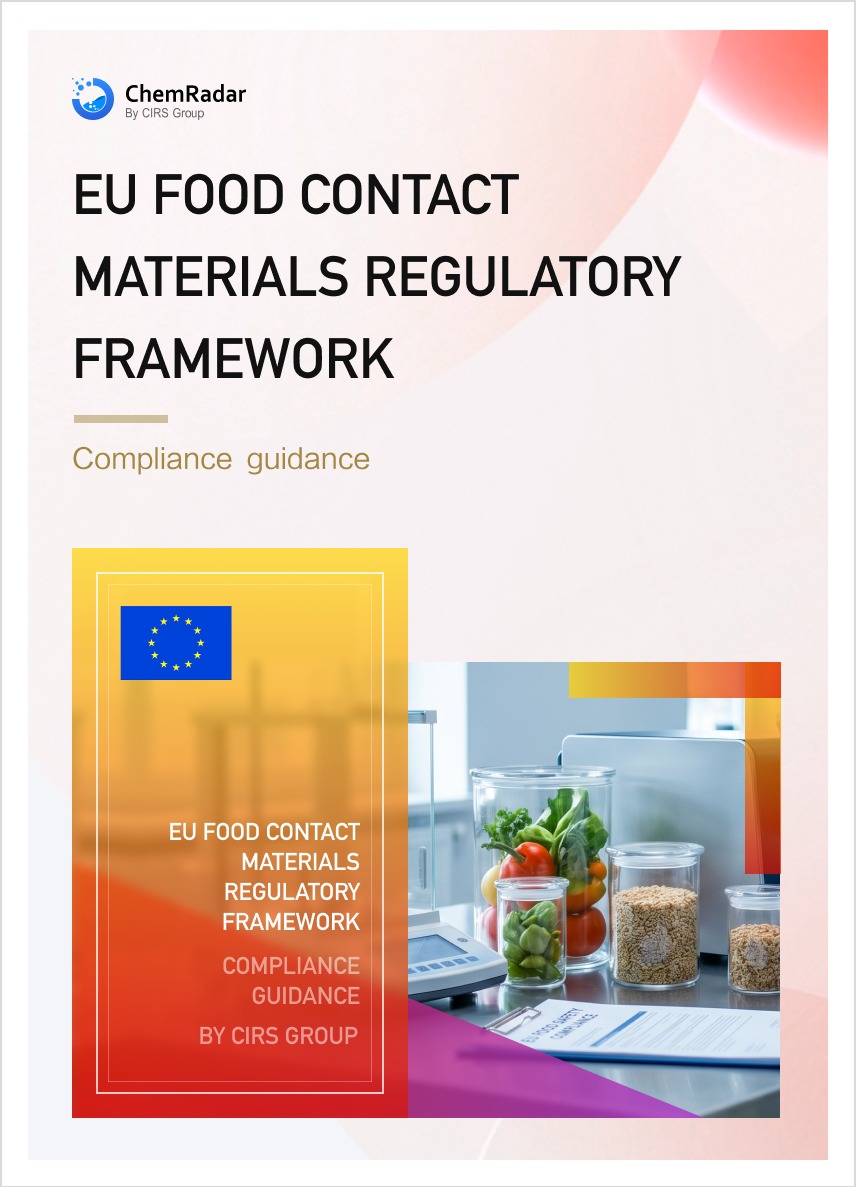
On October 28, 2026, the European Commission published Regulation (EU) 2026/2412, amending Annex I to Regulation (EU) No 10/2011 regarding the list of authorized substances for plastic food contact materials and articles, thereby incorporating four new substances into the Union list.

Newly Authorized Substances

The four substances added in this revision cover various fields, ranging from high-performance engineering plastics to bio-based materials. The EU has established strict regulations regarding their application scenarios, migration limits, and specific conditions:

  1. FCM No 1086 — Carbonized polyacrylonitrile chopped carbon fibres
    • Use: As a filler and reinforcing material in plastic food contact materials.
    • Restrictions: To be used only in polyether ether ketone (PEEK) polymers at a maximum level of 40% w/w; the carbon fibres must be manufactured from polyacrylonitrile with a carbon content of not less than 95% w/w, and none of their dimensions shall be in the nanoscale (diameter > 100 nm).
  2. FCM No 1087 — Precipitated calcium carbonate (nano), uncoated
    • Use: As a filler in all types of polymers, suitable for all food types.
    • Restrictions: Not to be used for infant formula; in uncoated particle form; overall migration shall be monitored to ensure compliance, particularly for acidic foods.
  3. FCM No 1088 — Poly(2-hydroxypropanoic acid), esters with 1-octanol and 1-decanol
    • Use: As an additive in polylactic acid (PLA) food contact materials at a maximum level of 15% w/w.
    • Restrictions: No starch or additives with similar function; restricted to specific foods (water, fresh fruit and vegetables, vinegar, etc.) under contact conditions of up to 10 days at 40°C; Specific Migration Limit (SML) of 0.05 mg/kg.
  4. FCM No 1090 — Mixture of 1,9-nonanediamine (NMDA) and 2-methyl-1,8-octanediamine (MODA)
    • Use: To manufacture polyamide materials and articles by copolymerization with terephthalic acid, suitable for all foods (except infant formula and human milk).
    • Restrictions: Total migration of NMDA and MODA shall not exceed 0.05 mg/kg; migration of components with a molecular weight below 1000 Da shall not exceed 5 mg/kg.

According to the regulation, this revision will enter into force on the 20th day following that of its publication in the Official Journal of the European Union.


Further information

Document

ChemRadar Copyright Disclaimers:

1. All texts, graphics, videos and audios with "Source: ChemRadar" on this website are copyrighted by ChemRadar. Without authorization, no media, website or individual is allowed to reproduce, link, distribute, publish, or copy any content in this website. Other media, website with our authorization shall indicate "Source: CIRS Group" when downloading or using relevant contents. Unauthorized actions will be persecuted.

2. Texts and graphics on thie website without "Source: ChemRadar" are reproduced for further information but not imply the endorsement of views or autheticity of its content. Other media, websites or individuals download or use relevant content shall remain its "Source" as prescribed in this website and bear corresponding legal responsibilities. Any unauthorized alternation to "Source: ChemRadar" may be persecuted. If you have any questions about relevant content on this website, please contact us.

3. If any content reproduced on ChemRadar raises copyright or other related issues, please contact us within two weeks.

4. CAS and CAS Registry Number are registered trademarks of the American Chemical Society. Any reference to such identifiers is made solely for the purpose of identifying chemical substances. ChemRadar is an independent platform and is not affiliated with, sponsored by, endorsed by, or an authorized partner of CAS or ACS. Based on CIRS’s current review, the identifiers displayed on this platform were not obtained directly from CAS REGISTRY or any CAS subscription product or service. They were collected from governmental regulatory publications and other independent third-party sources. Users should independently verify the information before relying on it.

Disclaimer
1.
CIRS aims to keep the content of this site accurate and up to date. However, CIRS makes no warranties or representations regarding the quality, accuracy, completeness or reliability of information on the site.
2.
In no event shall CIRS assume or have any responsibility or liability for any information on this site or for any claims, damages or losses resulting from their use.
3.
CIRS reserves the right, at our discretion, to change, modify, add to, or remove portions of information on this site at any time without notice.
4.
CAS and CAS Registry Number are registered trademarks of the American Chemical Society. Any reference to such identifiers is made solely for the purpose of identifying chemical substances. ChemRadar is an independent platform and is not affiliated with, sponsored by, endorsed by, or an authorized partner of CAS or ACS. Based on CIRS's current review, the identifiers displayed on this platform were not obtained directly from CAS REGISTRY or any CAS subscription product or service. They were collected from governmental regulatory publications and other independent third-party sources. Users should independently verify the information before relying on it.
icon-server
message
in